
How to Choose Security Lighting
Lighting a space at night is critical not only for capturing high-quality surveillance footage but also for deterring crime. Whether you’re managing a large-scale commercial site or upgrading a home security setup, the right lighting can significantly enhance overall protection.
Below are key considerations to help you select the best lighting for your security system.
Wavelength
Choose the Right Light Type: Infrared, White, or Hybrid
Power Input
Match the Light’s Power Input to Your System
Range & Angle
Match your camera’s field of view (FOV) to the light’s range & angle.
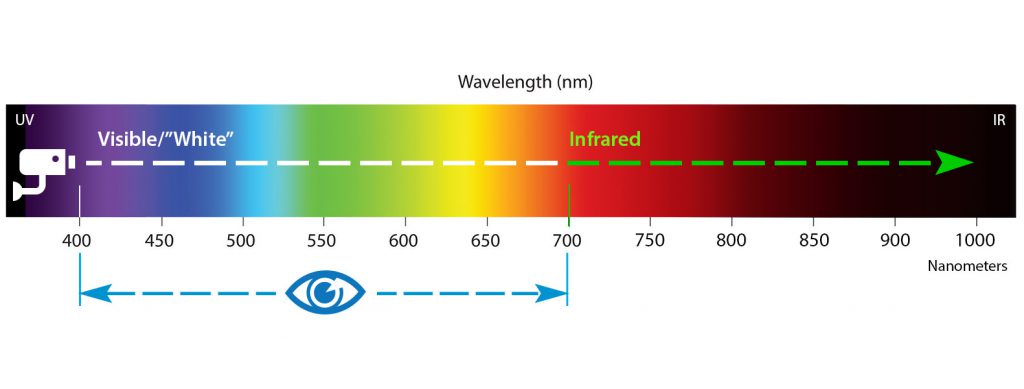
Light Wavelength Options
1. Infrared Light – Discreet surveillance without visible light
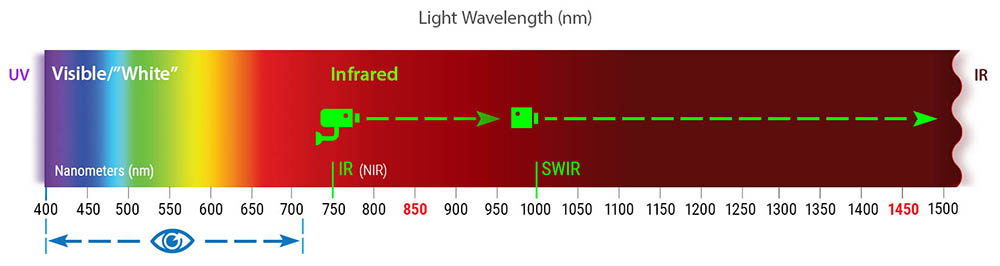
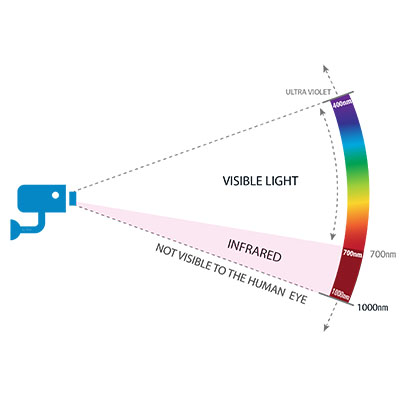
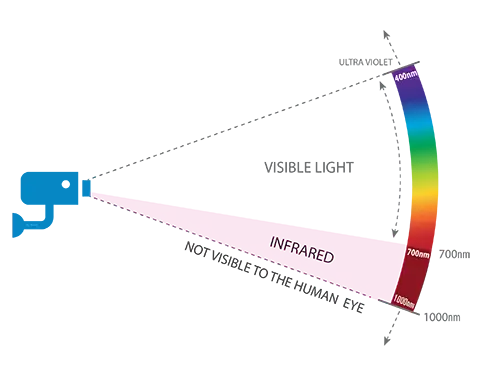
Infrared lighting, typically at 850nm, is invisible to the human eye but clearly visible to most IR-capable security cameras. An IR Illuminator allows discreet, around-the-clock surveillance. Scenes illuminated with IR will appear well-lit in camera footage while remaining completely dark to human observers. Infrared is commonly used in residential or environmentally sensitive areas where continuous White lighting may be a nuisance or contribute to light pollution.

ABOVE: Left – Security camera footage with an IR Illuminator. Right: Same scene without an IR Illuminator
IR Illuminators are ideal when:
See: IR Illuminators
2. White Light – Visible Illumination and Color Imaging
White floodlights provide visible illumination that supports both security and general area lighting. When used with a security camera, they enable full-color video, allowing details such as clothing colors, vehicle colors, and other visible features to be recorded.
White light can also serve as a visual deterrent by illuminating an area when activated. However, continuous white lighting may not be appropriate in every location. In residential neighborhoods and environmentally sensitive areas, excessive nighttime lighting can become a nuisance and contribute to light pollution.
AXTON White Floodlights are designed specifically for professional security applications. Built-in I/O ports allow the floodlight to be activated by motion sensors, security cameras, alarm systems, or other compatible control devices, providing illumination only when needed.
3. Hybrid Lights Infrared + White – Both covert monitoring and visible deterrence
AXTON Hybrid lights combine both IR and white LEDs in a single unit, offering flexible functionality.
In standard operation, the light runs in IR mode for invisible camera illumination. When triggered by a system component, such as a motion detector, contact sensor, or camera via I/O ports, the white floodlight activates. The activation of the bright white floodlight signals intruders that they’ve been detected and often causes them to flee before any damage is done. After the event, the light returns to IR mode for continued covert surveillance.
See: HYBRID Lights
Power Input Options
Your lighting should match your existing power setup, especially if you’re trying to avoid complex wiring or costly trenching for outdoor installations.
Voltage Options
PoE Power Input
AXTON offers PoE, PoE+, and PoE++ lighting options. These simplify installation by using the same cabling infrastructure that powers other system components, no additional electrical wiring required.
PoE Power Levels:
PoE lights are backward-compatible: a PoE+ light can operate on a PoE++ network, but not vice versa.
See: PoE Powered Lights
Solar / Battery Power – Low Voltage Input
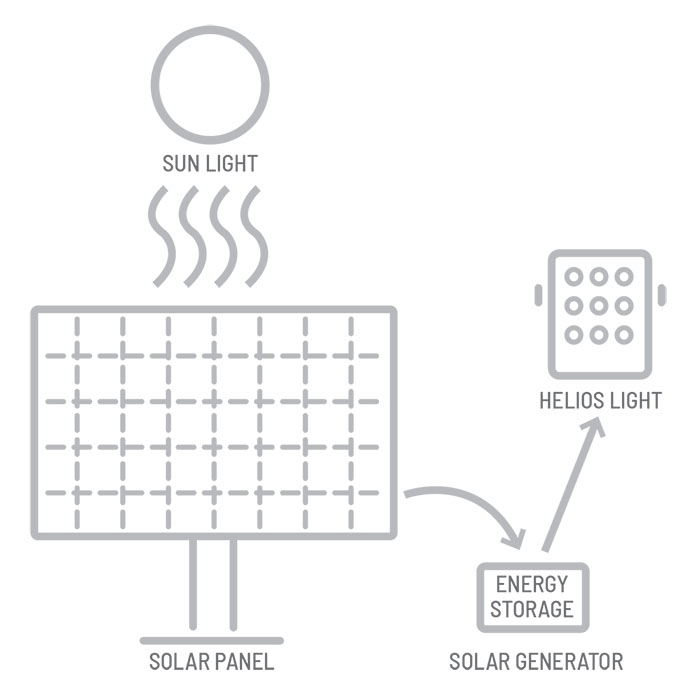
For remote, mobile, or solar-powered sites, AXTON offers low input voltage floodlights and IR illuminators compatible with solar powered, batteries, generators, off-grid systems. These lights are designed to work well with solar and battery output volatages.
Determine the Distance and Width (Angle) of Illumination You Need
You can control the distance and the width the light illuminates by choosing the lights angle. For security camera lights, match the light to your camera’s field of view. This ensures full coverage for you camera and is more efficient reducing energy costs. For AXTON lights angles range from wide angle 360˚ lights to narrow angle, long distance 10˚ lights and angles in-between those extremes.
Understanding Beam Angles and Illumination Range
Choosing the correct beam angle for your lighting can significantly improve system effectiveness and reduce energy costs.
TIP: If you are familiar with Google Earth it can be used measure your site’s area. For large security installations, AXTON offers free lighting plans to help you optimize light placement and performance.
Questions?
If you have questions about the best lighting for your site, feel free to contact us: call 801/519-0500 or email: Support at AXTONtech